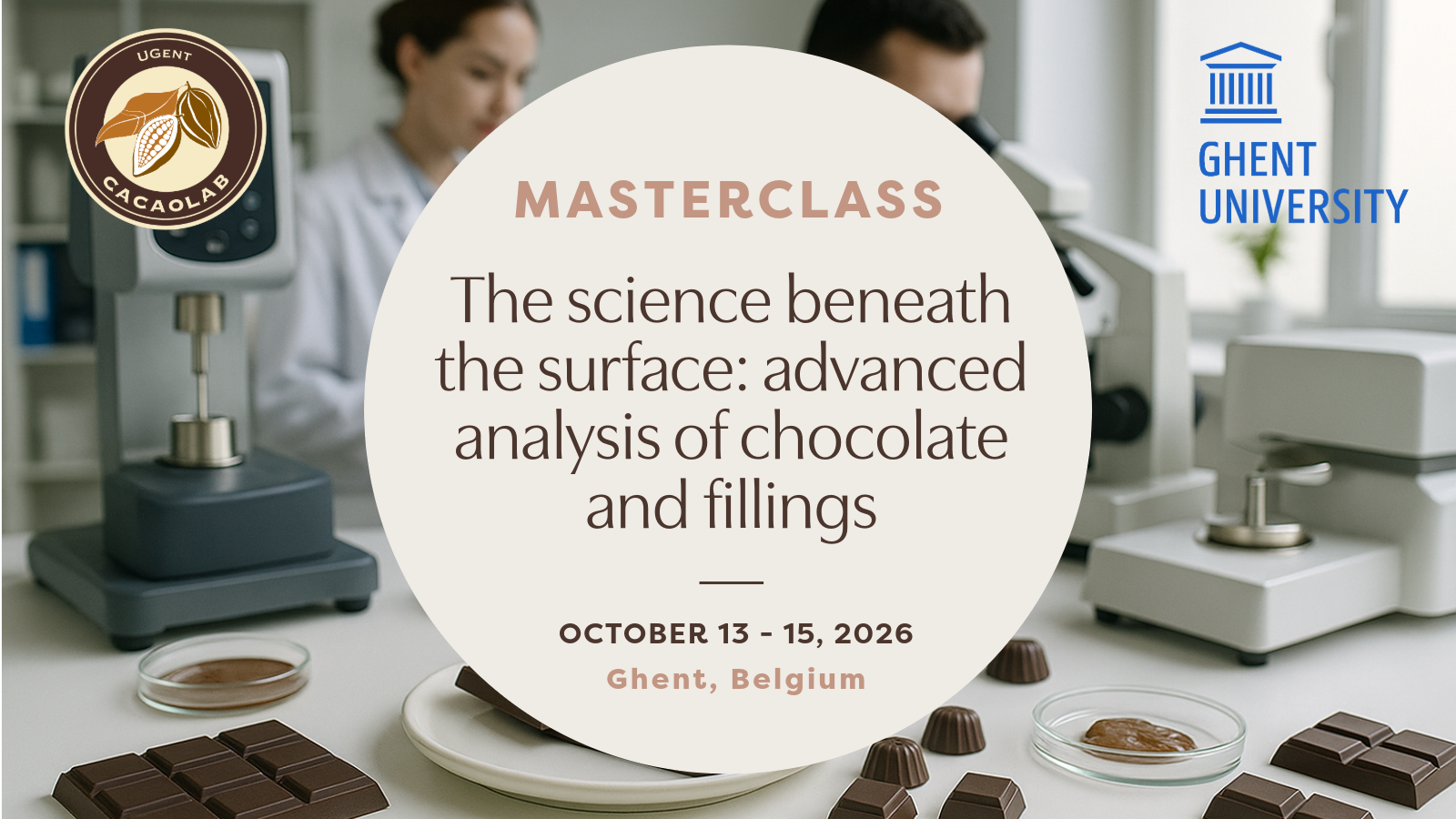
‘The science beneath the surface: advanced analysis of chocolate and fillings’ is a deep-dive masterclass designed for professionals and researchers in the chocolate and confectionery industry. This intensive course explores the complexity of chocolate and fillings through key analytical techniques: rheology and tribology, (modulated) differential scanning calorimetry, x-ray scattering and microscopy.
Explore the science of flow and deformation, focusing on how rheological properties influence processing, stability and sensory attributes. This section also introduces tribology, the study of friction and lubrication, as a powerful tool to better understand mouthfeel and textural dynamics during consumption.
Gain insights in the use of (M)DSC to study key thermal events including melting, crystallization and glass transitions. These techniques are essential not only for understanding phase transitions, but also for practical applications such as ingredient characterization or process optimization. From fine-tuning tempering protocols to ensuring shelf-life stability, thermal analysis provides valuable insights across product development and quality control.
Dive into the molecular and nanoscale structure of chocolate and fillings through the powerful techniques of small- and wide-angle X-ray scattering. This segment provides detailed insights into the internal organization of materials, revealing how crystalline material exists, evolves, and influences overall product performance.
Visualize microstructures using high-resolution microscopy methods, including polarized light microscopy, scanning electron microscopy and confocal laser scanning microscopy. This section highlights how microstructure relates to macroscopic properties such as texture, appearance and stability.
Program
-
Date: Tuesday October 13, 2026 (12:00-16:30)
Venue: Cacaolab (Ghent, Belgium)
Oscillatory rheology in food systems: linking microstructure to mechanical response
Oscillatory rheology is a technique to investigate the viscoelastic properties of food products, which originates from their intricate microstructures. In Small Amplitude Oscillatory Shear (SAOS) experiments, small deformations are applied to the material, allowing for the characterization of material’s viscoelastic behavior without altering its internal structure. This will be the focus of the first part of this lecture. Obtained parameters provide insights into the elastic and viscous properties and play an essential role in understanding texture and stability of food products. The second part of the lecture will delve into Large Amplitude Oscillatory Shear (LAOS) rheology, demonstrating how nonlinear rheological analysis can reveal structural breakdown mechanisms of food products under significant deformations. This approach is supported by advanced data processing techniques, providing a deeper understanding of how food structures respond to stress.
Understanding flow and tribological behavior in food systems
The flow behavior of food products is important with regards to food processing and sensory quality. In fat-based dispersions, this behavior becomes more complex due to the presence of a dispersed phase, leading to non-Newtonian characteristics. These can be studied through rotational rheology, which, depending on the sample, requires specific geometries to accurately measure parameters like yield stress, viscosity, and flow index. Tribology, on the other hand, offers insights into how materials behave between closely contacting surfaces. Originally associated with engineering applications (bearings, motors, brakes), tribology has become increasingly relevant in food science for assessing lubricative properties of food products. Within the oral cavity, the tongue and palate function as sliding surfaces, making tribological analysis key to understanding sensory attributes such as smoothness, creaminess, and astringency. This session introduces the core principles of rotational rheology and food tribology, during which some recent findings from the FSF research group on fat-continuous systems will be highlighted.
Lectures by:
Prof. dr. ir. Koen Dewettinck (Ghent University, Cacaolab bv)
Ir. Lennaert Sanders (Ghent University)
-
Date: Wednesday October 14, 2026 (09:00-12:30)
Venue: Cacaolab (Ghent, Belgium)
This lecture provides insights into Differential Scanning Calorimetry (DSC), along with illustrative examples of its application in food science. DSC measures the difference in heat flow between a sample and an inert reference as a function of time and temperature during heating, cooling, or isothermal conditions. It detects all physical and chemical transitions involving endothermic or exothermic events, as well as changes in specific heat capacity - capturing both the temperature and enthalpy of these transitions.
In food materials, DSC can reveal critical information such as melting and crystallization temperatures, crystallinity, polymorphic transitions, protein denaturation, and starch gelatinization. These insights are valuable for material selection, formulation and process optimization, product fingerprinting, competitive analysis, and troubleshooting during manufacturing.
Modulated DSC (MDSC) enhances traditional DSC by applying a sinusoidal modulation to the heating rate. This allows for the separation of overlapping thermal transitions, enabling more accurate interpretation of complex thermal events.
Lectures by:
-
Date: Wednesday October 14, 2026 (13:00-16:30)
Venue: Cacaolab (Ghent, Belgium)
X-ray scattering techniques are important to identify fat polymorphism. Especially in chocolate, it is aimed to crystallize the cocoa butter in the βV polymorph to obtain chocolates with the desired quality in terms of gloss, snap and mouthfeel. In a first part of this lecture, the theoretical background of X-ray scattering is explained. This includes the concepts of X-ray scattering, the equipment and the differences between WAXS, SAXS and USAXS. In a second part, more insights into the application of the different techniques are discussed. This will mainly focus on running an experiment followed by analyzing and interpreting the results.
Lectures by:
-
Date: Thursday October 15, 2026 (09:00-13:30)
Venue: Ghent University (Ghent, Belgium)
Most standard imaging methods used in biology and food research cannot be used for chocolate products, because of the fat continuous and dehydrated nature of these materials. Still many options are available, ranging from light microscopical analysis of melted/resolidified material between glass slides, to analysis of ingredient powders, to advanced Confocal and cryo-SEM imaging of fat crystal network in finished products. We will discuss the opportunities and challenges, trying to cover the field of multiscale chocolate product imaging. Examples from own work and from literature will be discussed, also in terms of practical applicability, artifacts, expenses, and alternatives.
Lectures by:
Registration
Participation options (excluding 21% VAT):
Choose the experience that suits you best:
Standard participation – € 1 950 per participant
Includes full access to the program, teaching materials, drinks, and sandwich lunches.All-in participation (including networking dinner) – € 2 025 per participant
Includes everything in the standard package, plus a group dinner on Wednesday October 14.
Group advantage:
Bringing colleagues? From the second participant of the same company onwards (one invoice per company):
€ 1 650 (standard) per additional participant
€ 1 725 (all-in with dinner) per additional participant
Certificate of participation is provided after completing the masterclass.
For employees of the Belgian food industry belonging to PC 118 or 220, Alimento provides a contribution to the registration fee of maximum € 300 per person (for a maximum of 3 people from the same company).
Contact: events@cacaolab.be
Target audience
This masterclass is targeting professionals working in R&D or QA in chocolate or related industries, as well as scientists doing research on chocolate technology & quality. A basic to intermediate understanding of analytical techniques (equivalent to a bachelor's degree in a scientific discipline) is required to fully benefit from this masterclass.
A maximum of 20 participants is accepted.
Testimonials of our last edition
Organizing committee
Cacaolab bv
Skaldenstraat 121, building A3/A4
9042 Desteldonk
Belgium
Food Structure & Function Research Group, Ghent University
Coupure Links 653
9000 Gent
Belgium
Cancellation Policy
If you registered for the Masterclass ‘The science beneath the surface: advanced analysis of chocolate and fillings’ and are subsequently unable to attend, you may be eligible for a refund subject to the following terms and conditions:
Up to September 13, 2026: Full refund of paid registration fee is possible, with a deduction of an administration fee of € 40.
Less than 1 month before the course starts: No refunds will be made (a colleague can take your place).
Cacaolab bv reserves the right to cancel any course for any reason. In the case of a course cancellation, a full refund will be issued to all registrants.
Privacy Policy and Copyright
Course materials are intended for your personal, educational use only. Any copying, transmission, performance, distribution, alteration, or other use of these materials is strictly prohibited without prior consent by Cacaolab bv.
By registering for or attending any Cacaolab event, you agree voluntarily to abide by the Cacaolab Privacy Policy.